Three Powerful AI-UGC SEO Strategies That Scale with Your Product

Most companies think about content marketing as a cost center — a function where writers churn out SEO pages, blog posts, and landing pages to slowly attract traffic.
But what if your product automatically generated SEO content every time someone used it?
That’s the power of AI-UGC SEO — a strategy where your users + your AI system = infinite content creation, without needing writers or agencies.
Today we’ll explore three powerful variations of this idea that can help any AI-enabled platform turn product usage into compounding search growth:
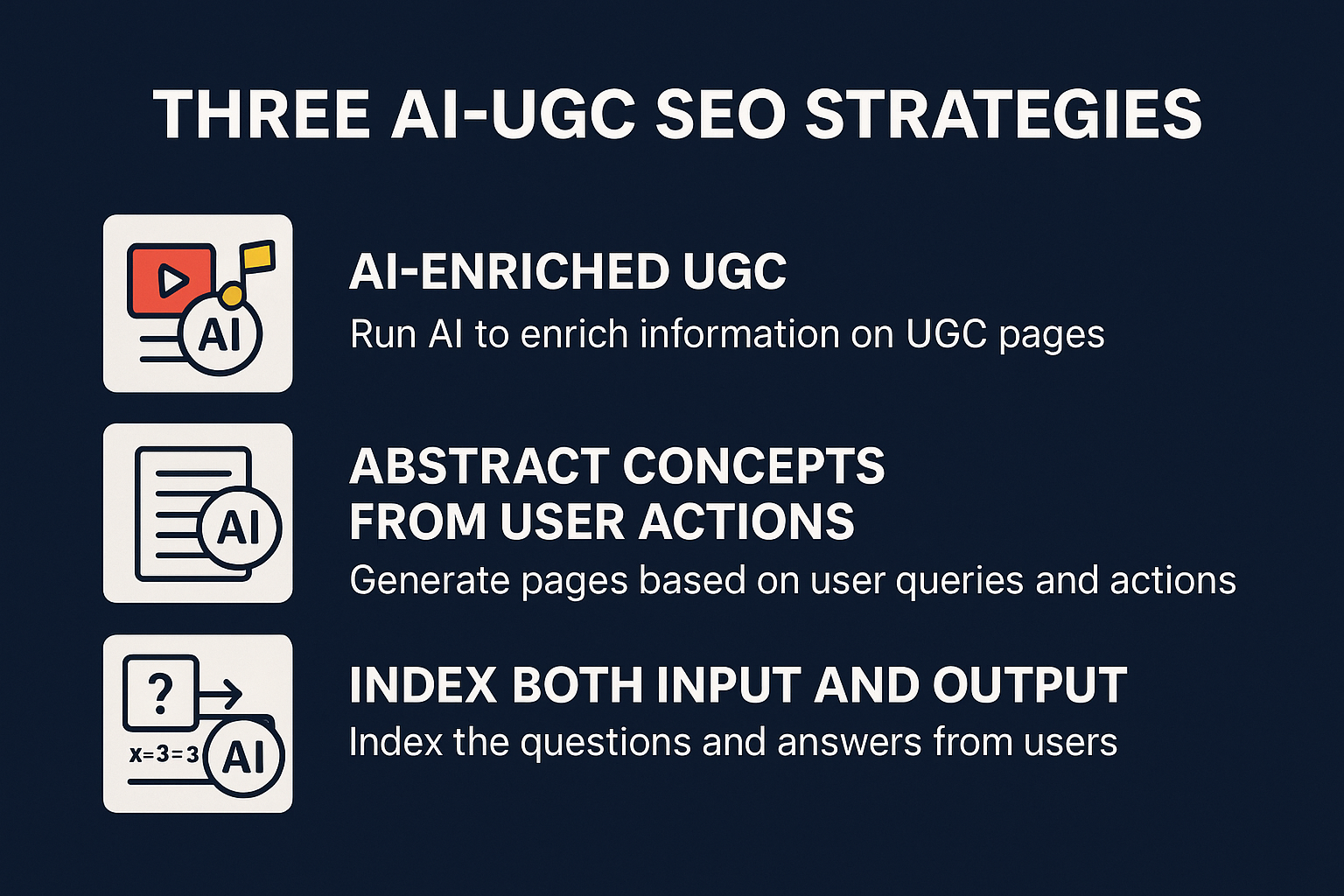
1. AI-Enriched UGC: Make Creative Content Indexable
Many platforms today generate user content — music, images, videos, 3D models, etc. But there’s a problem: Google doesn’t really “see” this content.
Search engines still rely heavily on text — titles, descriptions, tags, and structured data — to index and rank pages.
So how do you make multimedia content indexable?
With AI-enriched UGC, you let your AI system analyze creative outputs and auto-generate metadata around them. Think of it like turning raw content into search-optimized content.
Example:
- A user generates an AI music track using your platform. Your system can automatically generate:
- A title: “Ambient Lo-Fi Track in C Minor”
- A description: “Chill background music ideal for study sessions or YouTube vlogs”
- Tags: “lofi, ambient, AI music, study beats”
- An FAQ: “How do I use AI to generate royalty-free music?”
Result: You turn a silent URL into a rich SEO asset.
2. Abstract Concepts from User Actions
Sometimes, users do complex things with your platform that don’t map to clear keywords. But your AI can abstract those use cases into high-intent, long-tail SEO pages.
Example:
- A user uploads 100 resumes from Harvard students to evaluate candidates for a Kenya-based study abroad program.
- Your AI turns that session into a page like:
- “AI Resume Screener for Given Criteria”
This strategy is about generalizing the intent, not indexing raw user data.
More examples:
- A user compares customer feedback from different regions. The system generates:
- “Regional Sentiment Analysis Tool: Compare Customer Feedback by Country with AI”
- A user fine-tunes job descriptions for hiring machine learning engineers.
- Page generated: “AI Tool to Optimize Job Descriptions for Technical Roles”
In all cases, you're turning specific tasks into generalized, SEO-relevant landing pages.
3. Index Both Input and Output
If users ask your tool a question — and your AI gives a high-quality answer — you have two pieces of unique, indexable data: the input and the output.
So don’t just show the result. Turn the whole exchange into an SEO page.
Example:
- User types: “Solve x² - 5x + 6 = 0”
- AI responds: “x = 2 or x = 3. Here's the step-by-step process...”
The generated page becomes:
“How to Solve x² - 5x + 6 = 0 with AI — Step-by-Step Guide”
More examples:
- User asks: “What are the key ideas in ‘Superintelligence’ by Nick Bostrom?”
- Page: “AI Summary of Superintelligence by Nick Bostrom”
- User requests: “Translate this contract from French to English and summarize it”
- Page: “AI Legal Translation and Summary: French to English Contract Sample”
These pages mirror real user intent, are keyword-rich, and provide clear value — all without human writers.
Final Thought: AI-UGC SEO Is a Growth Flywheel
How to determine which approach to follow? Think about how your target users search, and what kind of content fulfills their search intent.
This approach isn’t just efficient. It compounds:
- Product usage → Indexed content → Organic search → More users → More usage → More content → Repeat
It’s authentic. It’s scalable. It’s privacy-safe (when done right). And it works especially well in domains where AI is doing real cognitive tasks: parsing, summarizing, answering, generating.
So if you're building an AI product — don’t just think about features.
Think about how your users’ actions can become content.
That’s where the next wave of SEO growth will come from.