The Best SEO/GEO Strategy for AI Content Tools: AI UGC SEO
AI content tools have a unique SEO advantage that most software companies do not have:
their users are constantly creating content that can become search assets.
Every generated video, music track, audio file, financial analysis, prompt, workflow, and AI output can reveal what users actually want.
Instead of treating those outputs as content that disappears after the user finishes a task, AI companies can turn selected outputs and use cases into indexable, search-friendly pages.
This is the core of our approach:
Product usage → user intent → AI-generated content → SEO/GEO pages → more search visibility → more users
We call this AI-UGC SEO: using AI-user-generated content and product usage signals to build scalable SEO and GEO content.
For AI content tools, this can become one of the strongest forms of Product-Led SEO.
Why AI Content Tools Have a Unique SEO Advantage
Traditional SEO usually works like this:
Find keywords → hire writers or use AI → create articles → wait for rankings.
AI content products can work differently.
Users are already telling you what they want every day through the product.
For example:
| AI Product | What the User Does | Searchable Intent |
|---|---|---|
| AI Music Video Tool | Turns a song into a music video | AI music video generator, create music video from song |
| AI Video Tool | Generates videos from prompts, images, or scripts | AI video generator, image to video AI |
| AI Audio Tool | Generates, converts, separates, or analyzes audio | AI audio generator, vocal extractor, audio to MIDI |
| AI Financial Analysis Tool | Analyzes stocks, portfolios, indices, or datasets | NASDAQ vs S&P 500 analysis, portfolio risk analysis |

The user activity itself becomes a source of keyword research.
And the generated output becomes potential page content.
This is fundamentally different from mass-producing generic AI-written blog posts.
The content originates from real product usage and real user intent.
The AI-UGC SEO Framework
There are two major ways we turn product usage into SEO and GEO assets.
Strategy 1: Publish Valuable AI-Generated Outputs
When users generate useful or interesting public content, selected outputs can become individual webpages.
For example:
- An AI-generated music video becomes a public music video page.
- An AI-generated video becomes a showcase page.
- An AI financial analysis becomes a research page.
- An AI audio workflow becomes a demonstration or result page.
Each page can contain:
- A clear SEO title
- The generated output
- A description of what was generated
- The original use case or generalized intent
- Supporting explanation
- Related examples
- Internal links
- A CTA back into the product
The result is a page that is both useful to users and understandable to search engines and AI answer engines.
Strategy 2: Abstract Product Usage Into Use-Case Pages

Not every user interaction should become a public page.
Instead, we can identify repeated patterns in user behavior and turn those patterns into broader pages.
For example:
User action: Upload a song and generate a synchronized video.
SEO page:
How to Create an AI Music Video From a Song
Or:
User action: Extract melody from vocals and convert it into MIDI.
SEO page:
AI Vocal-to-MIDI Converter: Extract Melody From Any Song
Or:
User action: Compare NASDAQ-100 and the S&P 500 across different holding periods.
SEO page:
NASDAQ-100 vs S&P 500: Historical Return and Risk Analysis
The individual user interaction gives us the signal.
The final page targets the broader search demand.
Four AI-UGC SEO Case Studies
Case Study 1: AI Music Video Tools
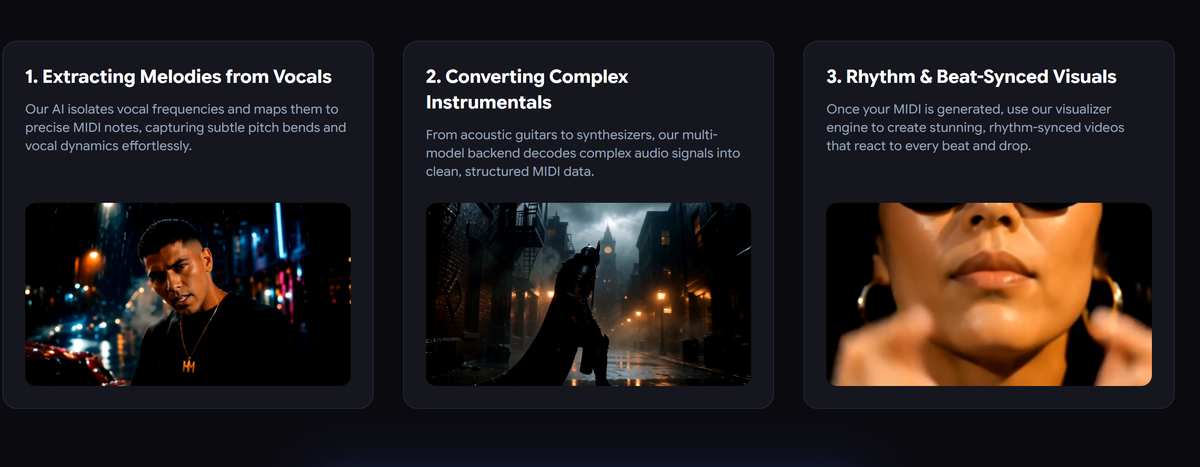
AI music video products are especially well suited to AI-UGC SEO because every generation can potentially create a unique visual asset.
A user might upload a song, choose a style, and generate a complete music video.
Instead of allowing that output to exist only inside the application, the product can turn selected public generations into searchable pages.
Example Page Structure
Title:
AI Music Video Generated From Electronic Music
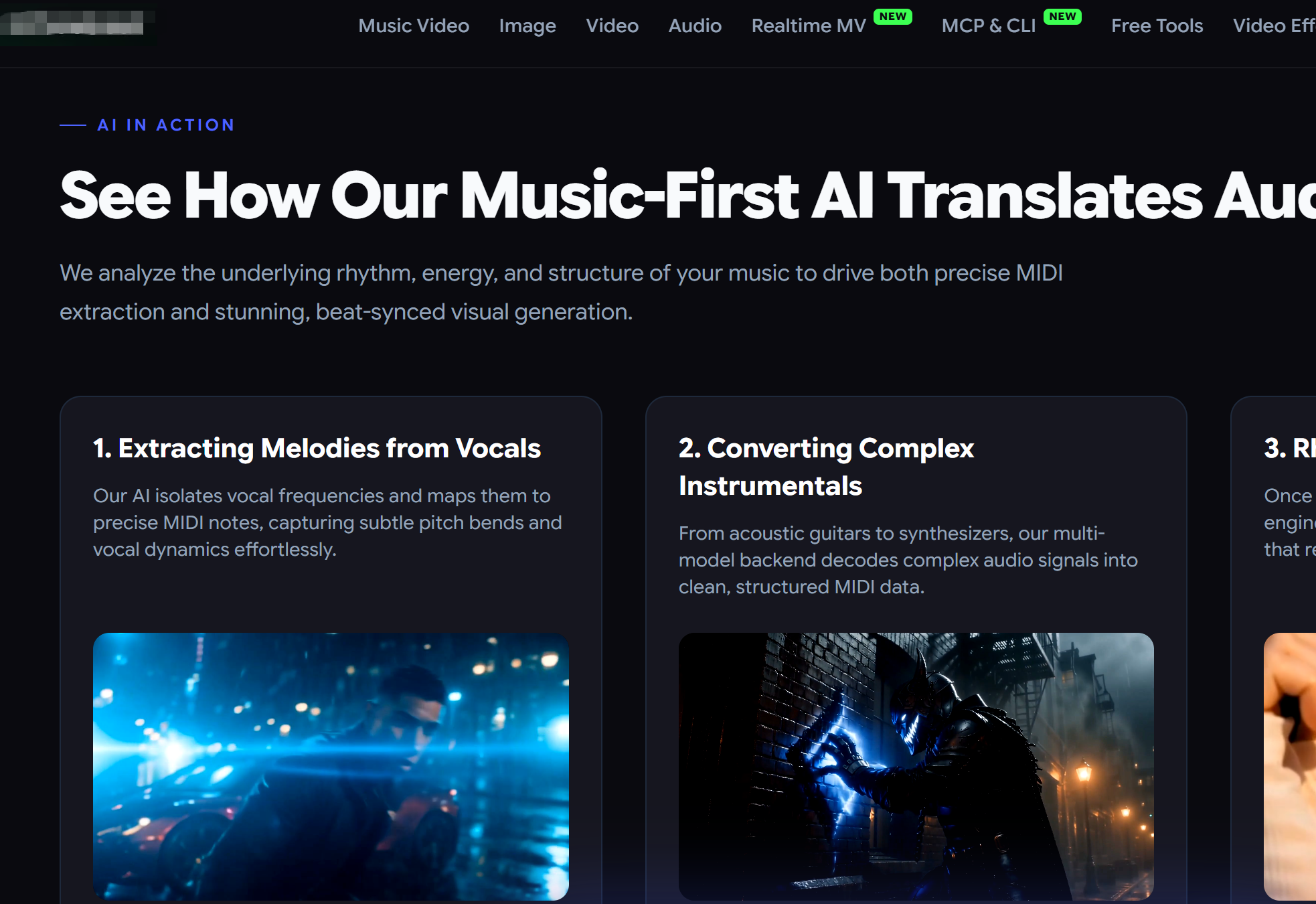
Page content:
- Generated music video
- Song or music style
- Visual style
- Description of the generation
- How the AI interpreted rhythm and beats
- Similar generated videos
- CTA: Create your own AI music video
This gives the product a way to cover thousands of long-tail combinations such as:
- AI music video for electronic music
- AI music video for hip-hop
- AI music video for instrumental music
- AI animated music video
- AI cinematic music video
- Generate music video from song
- Music visualizer with AI
The generated content itself becomes evidence that the product can perform the task.
That is much stronger than writing a generic article saying, “Our AI can generate music videos.”
GEO Advantage
These pages also give AI search engines more specific evidence about what the product can do.
Instead of simply seeing a homepage saying:
“We are an AI music video generator.”
AI systems can discover dozens or thousands of concrete examples showing:
- what inputs the product handles,
- what types of videos it generates,
- which styles it supports,
- and what kinds of user problems it solves.
This creates much deeper semantic coverage.
Case Study 2: AI Video Tools
AI video tools can generate huge numbers of unique outputs from text, images, characters, products, or creative concepts.
This creates another major AI-UGC opportunity.
A typical AI video generation might be:
Input:
A user asks the AI to create a cinematic superhero scene.
Output:
The AI generates a finished video.
That output can become a structured page around the broader use case.

Potential SEO Pages
- AI superhero video generator
- Turn images into cinematic AI videos
- AI character animation generator
- Generate product videos with AI
- AI movie scene generator
- Text-to-video AI examples
- Image-to-video AI examples
Instead of producing hundreds of generic SEO articles, the company can create real examples of the product performing each task.
Recommended Page Structure
Each page can include:
- The generated video
- The use case
- The prompt or a generalized version of the prompt
- How the output was created
- Recommended settings or workflows
- Related generations
- A direct product CTA
This makes the page useful even before the visitor signs up.
The user sees the outcome first.
Then the product becomes the tool for reproducing that outcome.
Case Study 3: AI Audio Tools
AI audio products can use a slightly different AI-UGC model.
The strongest opportunities are often not individual generated files, but specific transformations and workflows.
For example, users might repeatedly perform tasks such as:
- Extract vocals from music
- Extract melodies
- Convert audio into MIDI
- Remove background music
- Generate instrumentals
- Separate stems
- Analyze rhythm
- Synchronize audio with video
Each repeated workflow can become a search landing page.

Example
A user uploads a song and uses an AI tool to extract the vocal melody into MIDI notes.
That interaction tells us there is a real user need.
Instead of publishing the user's specific file, we can abstract the intent into:
Extract Vocal Melody to MIDI With AI
The page can explain:
- What vocal-to-MIDI conversion is
- How the AI identifies pitch
- How melody extraction works
- What types of audio are supported
- Example outputs
- Related workflows
- How to perform the task using the product
The same product could systematically generate pages around:
| User Workflow | SEO Page |
|---|---|
| Extract vocals | AI Vocal Extractor |
| Convert melody to MIDI | Audio to MIDI Converter |
| Separate instruments | AI Stem Separator |
| Identify beats | AI Beat Detection |
| Generate music visuals | Audio Reactive Video Generator |
| Remove vocals | AI Karaoke Maker |
The important point is that the product usage determines which pages deserve to exist.
You do not need to guess all the possible keywords upfront.
Your users help reveal them.
Case Study 4: AI Financial Analysis Tools
AI financial analysis tools have a different kind of UGC.
The output is not necessarily creative media.
It may be:
- tables,
- portfolio analysis,
- market comparisons,
- risk analysis,
- historical data,
- charts,
- investment scenarios,
- or quantitative research.
This can still become powerful AI-UGC content.
For example, a user asks the system to compare the NASDAQ-100 and S&P 500.
The AI analyzes:
- rolling returns,
- median returns,
- downside periods,
- volatility,
- holding periods,
- currency effects,
- or withdrawal resilience.
Instead of keeping that result inside a private chat interface, appropriate public or regenerated analysis can become a structured research page.

Example
NASDAQ-100 vs S&P 500 Portfolio Analysis
The page can contain:
- 1-year historical return ranges
- 3-year historical return ranges
- 5-year historical return ranges
- median returns
- worst historical outcomes
- volatility comparison
- currency impact
- explanation of the results
- related market comparisons
Now the product can potentially create similar pages around:
- NASDAQ-100 vs Dow Jones
- S&P 500 vs Russell 2000
- Gold vs S&P 500
- Bitcoin vs S&P 500
- US stocks vs European stocks
- Growth stocks vs value stocks
- Hedged vs unhedged portfolios
Each user analysis can reveal another search demand pattern.
The strongest ones can be converted into standardized public research pages.
Why This Is Powerful for GEO
Financial queries are especially suited to structured content.
AI answer engines can more easily understand pages containing:
- tables,
- definitions,
- comparisons,
- explicit questions and answers,
- clear methodology,
- and structured conclusions.
A well-designed financial analysis page is therefore not only an SEO asset.
It can also become a source that AI systems understand and potentially reference when answering related questions.
The Difference Between AI-UGC SEO and Mass AI Content
This distinction is extremely important.
AI-UGC SEO does not mean generating 100,000 random AI articles.
That approach is easy to copy and often creates low-value pages.
The stronger model is:
Use proprietary product activity to decide what content should exist.
| Generic AI SEO | AI-UGC SEO |
|---|---|
| Starts with generic keyword lists | Starts with real product usage |
| AI invents the content | Content is based on real tasks and outputs |
| Weak connection to the product | Direct connection to product functionality |
| Easy for competitors to replicate | Built on proprietary usage data |
| Content is the marketing layer | The product itself creates the content |
| Mostly targets Google | Designed for both search engines and AI engines |
That is why we believe AI-UGC can become a genuine SEO moat for AI products.
The moat is not AI-generated text.
Everyone has access to AI-generated text.
The moat is:
proprietary user intent + proprietary outputs + structured publishing + SEO/GEO optimization + continuous feedback.
How We Build the System
Our approach typically has five stages.
1. Identify High-Value Product Usage
We analyze what users actually do inside the product.
We look for repeated actions such as:
- generate
- convert
- analyze
- summarize
- extract
- compare
- edit
- transform
- visualize
Then we determine which actions map naturally to search demand.
2. Turn Product Usage Into Keyword Patterns
Instead of thinking about keywords one by one, we identify templates.
For an AI video company:
AI video for {use_case}
Generate {video_type} with AI
Turn {input_type} into video
For an AI audio company:
Convert {audio_type} to {output_type}
Extract {element} from {audio_type}
For a financial AI company:
{asset_1} vs {asset_2}
{asset} historical return analysis
Best portfolio for {scenario}
This allows thousands of specific pages to come from a relatively small number of strong patterns.
3. Decide Whether to Publish, Abstract, or Regenerate
There are several ways to handle user-generated material.
A product can:
- publish content that is already intended to be public,
- publish content where appropriate permission exists,
- extract only the underlying user intent,
- anonymize the content,
- or generate a completely new example based on the use case.
The correct method depends heavily on the product and the sensitivity of the data.
For many B2B and financial products, abstracting the intent instead of publishing the original user input is usually the safer architecture.
4. Generate Search-Optimized Pages
Each page should be built around the search intent rather than simply dumping raw AI output onto a URL.
A strong page normally contains:
- Clear H1
- Immediate answer or result
- Generated output
- Explanation
- Structured tables or steps
- Relevant examples
- Related use cases
- Internal links
- Product CTA
- SEO metadata
- Structured data where appropriate
The goal is not:
Generate as many pages as possible.
The goal is:
Generate as many useful pages as possible.
5. Use SEO and GEO Performance as the Feedback Loop
After publishing, the system should learn from performance.
We track:
- Google indexing
- impressions
- clicks
- keyword rankings
- conversion
- AI mentions
- AI citations
- page quality
- user engagement
Pages and patterns that perform well should expand.
Pages that receive no demand or provide little unique value should be improved, consolidated, or removed.
This turns AI-UGC SEO from a publishing engine into a learning system.
The AI-UGC Growth Flywheel
The long-term opportunity is simple:
More users
↓
More product interactions
↓
More intent and content signals
↓
More useful SEO/GEO pages
↓
More Google and AI search visibility
↓
More users
That creates a growth loop that traditional content marketing struggles to reproduce.
For AI content tools in particular, this can be extremely powerful because the product is already generating the raw materials.
The company does not need to build a completely separate content operation.
Instead, the product itself becomes the content engine.
The Winning Strategy for AI Content Tools
For AI music video, AI video, AI audio, and AI analysis products, the strongest SEO strategy is increasingly not simply:
“Write more blog posts.”
It is:
Turn what the product already creates into a scalable search and AI-discovery layer.
AI content companies already possess three valuable assets:
- User intent
- Generated content
- Product-specific data
AI-UGC SEO connects those assets with SEO and GEO.
That is the opportunity.
Your users use the product.
Their usage reveals demand.
The product creates the content.
The content creates search visibility.
Search brings the next generation of users.
For AI-native products, that may become one of the most important forms of Product-Led Growth.