Programmatic SEO + GEO for Niche B2B and Healthcare: Two Case Studies

Most companies are sitting on data that search engines and AI assistants never see — product specs, service lines, clinical capabilities, pricing — because none of it has been turned into proper, indexable web pages. Programmatic SEO fixes that by generating hundreds or thousands of high-intent pages from a company's own data. GEO (Generative Engine Optimization) extends the same idea to AI: getting those pages cited inside ChatGPT, Google AI Overviews, Perplexity, and Bing.
Below are two live deployments built on this approach — one in industrial manufacturing, one in private healthcare — followed by a practical playbook for doing this in any category:
Case 1, SinoUnited Health (SUH)
Case 2, Lurun Tarpaulin
The two companies at a glance:
Lurun Tarpaulin is a PE & PP waterproof tarpaulin manufacturer and exporter based in China (Shandong region). It's an industrial B2B / global wholesale play. Its buyers are bulk importers, sourcing agents, distributors, and construction & logistics firms. It has published around 190 English pages. The buying behavior is research-heavy, comparison-driven, and price-sensitive.
SinoUnited Health (SUH) is a high-end private healthcare and hospital group in Shanghai serving expats and international patients. It's a premium private medical services play. Its "buyers" are patients and families choosing oncology, pediatrics, eye care, women's health, and dermatology. It has published around 366 pages across English, Chinese (Simplified), and Arabic. The decision style is high-trust, high-anxiety, and reputation-driven.
Case 1, SinoUnited Health (premium healthcare):
SUH is a private hospital group in Shanghai. Its patients are often expats, international families, and affluent locals choosing where to get cancer care, pediatric treatment, eye surgery, or a health checkup. This is a high-trust, high-anxiety category — people research heavily before booking. The SUH build is larger and more sophisticated than Lurun's in two ways: multilingual and service-line depth.
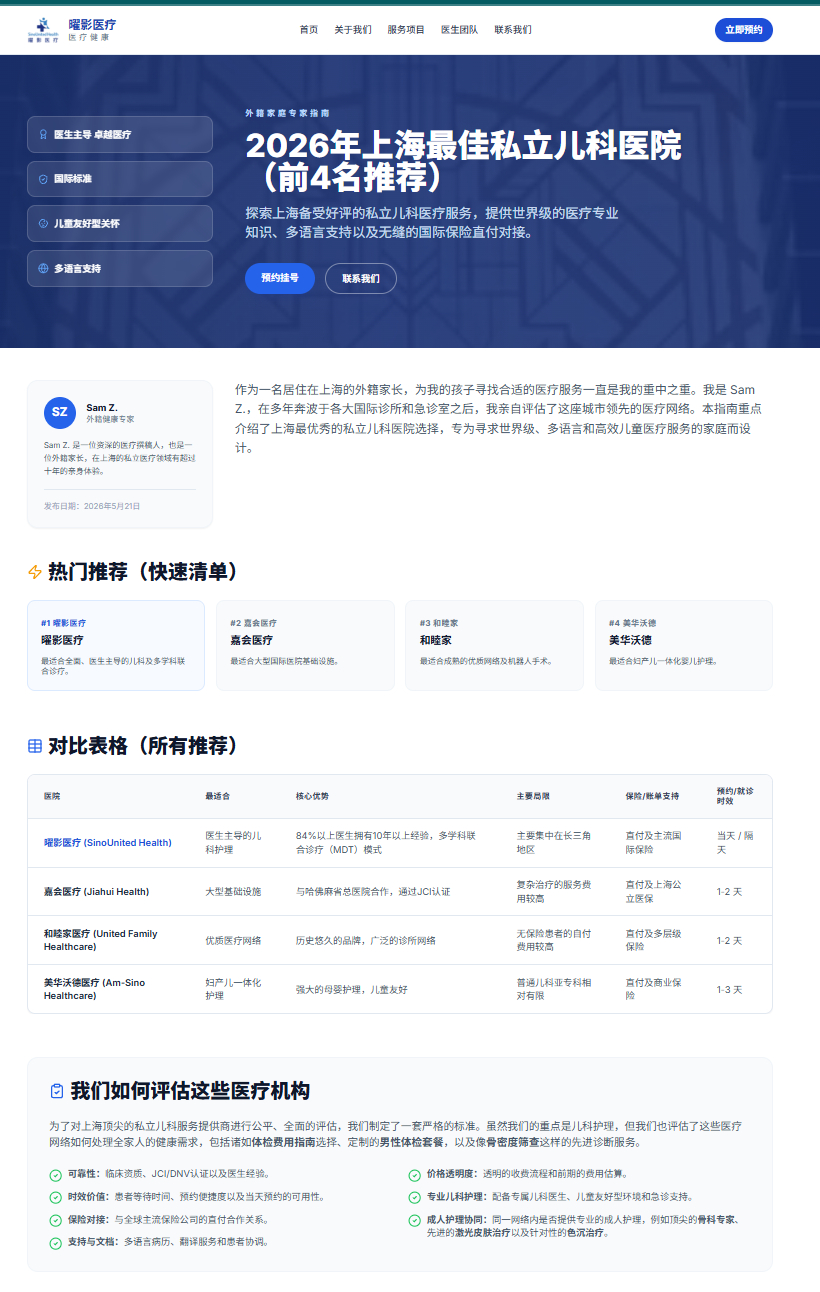
- Multilingual coverage: each topic is published in English, Chinese (Simplified), and Arabic — capturing local patients, the expat community, and Middle Eastern medical travelers.
- Service-line breadth: oncology, pediatrics, ophthalmology, dermatology, women's health, orthopedics, cardiac, and health checkups.
- Comparison pages: "Best private cancer hospital," "Top 4 pediatric clinics" — captures patients in active vendor-selection mode.
- Cost-guide pages: "Myopia Surgery Cost Guide," "Pediatric Checkup Cost Guide" — captures the single biggest pre-booking question.
- Condition pages: "Best Eczema Treatment Center," "Macular Degeneration Treatment" — captures symptom-driven searches.
Why it works for this category: cost-guide pages are a standout move. In healthcare, "how much does X cost" is the highest-intent, most-searched, least-answered query, and owning it builds trust and pulls in ready-to-book patients. Multilingual pages multiply reach without multiplying effort — the same clinical data is repurposed across three audiences. And naming real comparators (e.g., listing itself alongside Am-Sino and Jiahui Health) is exactly the structured, comparative content that LLMs lift into answers.
What the two cases have in common:
Despite being in completely different industries, both follow the same underlying pattern. Both turn proprietary data into pages — Lurun uses product specs, materials, and factory capabilities; SUH uses service lines, conditions, and clinical capabilities. Both match real search intent — Lurun on material × use-case × region; SUH on condition × service × language × cost. Both cover the full funnel — Lurun from how-to to comparison to supplier; SUH from symptom to cost to clinic selection. Both build for AI citation with ranked lists, comparisons, and quotable tables. And both scale via automation — 190 pages for Lurun, 366 across three languages for SUH.
How to do programmatic SEO + GEO for a company in this category (a repeatable playbook, in order):
- Inventory your proprietary data — product catalogs, SKUs, specs, and materials for manufacturing; service lines, conditions treated, procedures, and pricing for healthcare/services; plus reviews, case studies, certifications, and comparison data.
- Map the search-intent matrix — break your category into the dimensions buyers combine. Manufacturing: material × use-case × region × buying stage. Healthcare: condition × service × language × cost × location.
- Choose your page archetypes — the same handful works across industries: comparison/ranking lists, collection pages, use-case/condition pages, cost & buying guides, geo pages, and authority hub pages.
- Cover the full funnel, not just bottom-of-funnel — educational and how-to content earns the topical authority that makes both Google and AI trust your commercial pages.
- Build explicitly for GEO — AI assistants quote structured, comparative, factual content, so prioritize ranked lists with clear criteria, comparison tables, and direct answers to "how much," "which is best," and "how to choose."
- Go multilingual if your audience is — SUH's three-language build is the clearest lever for reach: one dataset, several markets.
- Automate generation and let live data optimize it — manual page-by-page production doesn't scale to hundreds of pages. Automated generation (e.g., via layerarc) plus continuous optimization against real Search Console / Bing signals is what makes the volume sustainable.
Case 2, Lurun Tarpaulin (industrial B2B manufacturing):
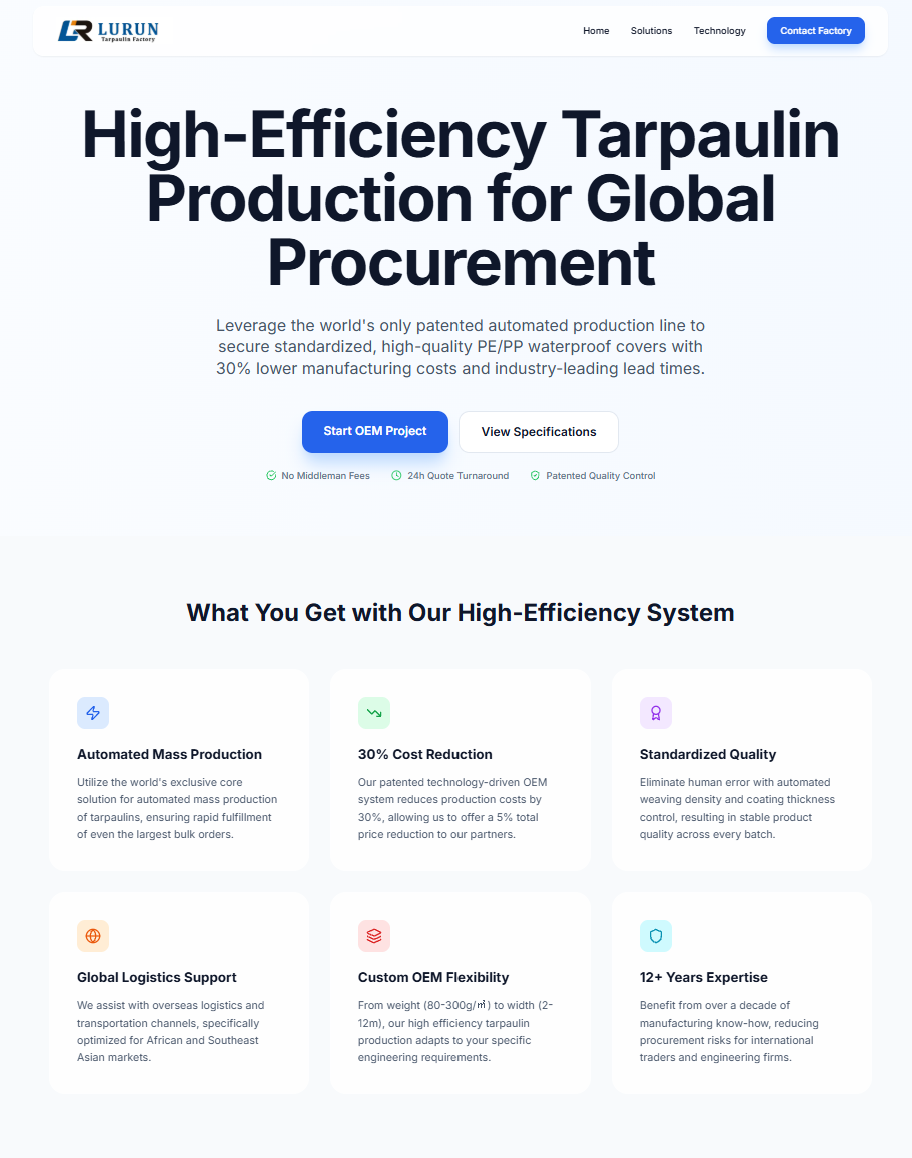
Lurun manufactures PE and PP waterproof tarpaulins and sells them in bulk to global B2B buyers. Tarpaulin sourcing is a classic long-tail category: buyers don't search one keyword — they search hundreds of very specific variations by material, use case, region, and buying intent. The programmatic build maps directly to how buyers actually search:
- Lists / rankings capture "best / top suppliers" intent (buyer comparing vendors). Example: "6 Most Reliable Tarpaulin Factories in China (2026)."
- Collections capture product + attribute combinations. Example: "Double Coated Waterproof Tarpaulin Wholesale."
- Use-case pages capture an application-specific need. Example: "Heavy-Duty Flood Protection Tarps for Emergency Infrastructure."
- Geo pages capture region-specific sourcing. Examples: "Best Tarpaulin for Africa," "Vietnam Tarpaulin Wholesale Market."
- How-to articles capture top-of-funnel education. Example: "How to Reduce Tarpaulin Procurement Costs by 30%."
- Hub pages act as authority / brand anchors. Example: "The Ultimate Guide to Patent-Driven Tarp Manufacturing."
Why it works for this category: every page targets a distinct buying phrase a procurement manager would actually type, so there's almost no internal keyword cannibalization. The mix of comparison, use-case, and geo pages covers the full funnel — from "how do I choose" to "who do I buy from in my country." Educational and how-to pages build topical authority, which is exactly the signal AI assistants reward when deciding which manufacturer to cite.
The takeaway: more high-intent, well-structured pages means more search coverage, which means more traffic and more AI citations. The data you already own is the raw material. Lurun proved it works for niche industrial B2B; SUH proved it works for trust-heavy, multilingual healthcare. The same playbook applies to almost any category.
Live examples: Lurun Tarpaulin articles (https://luruntarp.com/articles) and SinoUnited Health articles (https://www.suhhealth.com/articles/).
One quick flag worth keeping in mind: I kept the metrics qualitative since I don't have verified traffic figures for either domain — if you have the actual click or AI-citation numbers, I can fold them in. Also, SUH's article index is currently set to noindex/nofollow while Lurun's is indexable, which is worth checking if you want both fully discoverable.