How to use AI to supercharge your B2B Marketing - Ultimate Guide 2026
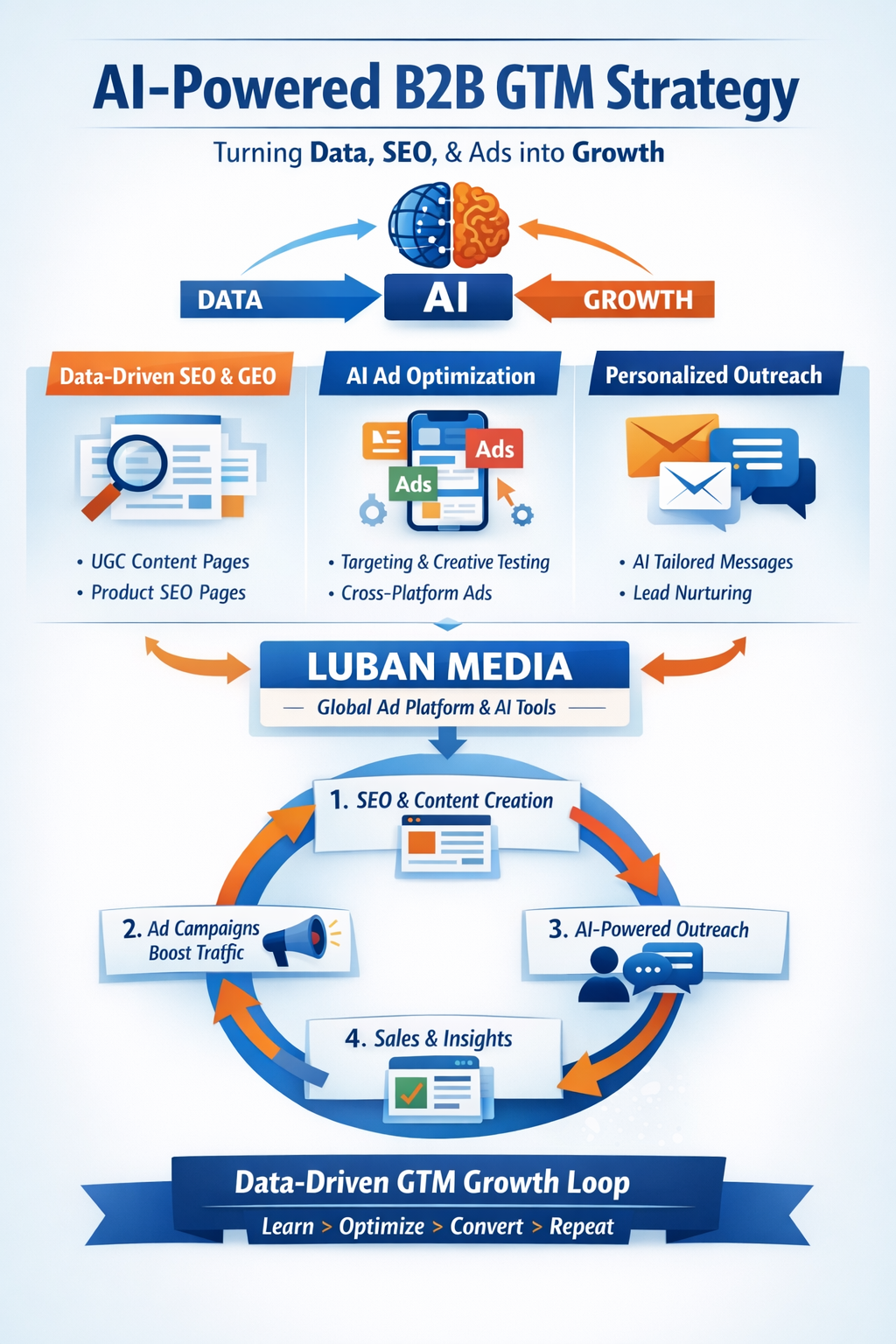
As B2B companies compete globally, the traditional go-to-market playbook—manual content creation, outbound sales lists, and isolated ad campaigns—is rapidly becoming outdated. The emergence of AI has fundamentally changed how companies generate demand, distribute content, and convert leads.
Today, the most successful B2B organizations are building AI-driven GTM engines that turn internal data into scalable marketing assets. Instead of creating a few marketing campaigns each quarter, they convert product data, usage data, and market insights into thousands of SEO pages, optimized ad campaigns, and personalized sales messages.
At CapGo, we are an AI SEO, GEO company, we partnered with different Platforms and marketing ecosystems like Luban Media (https://lubanmedia.com/index), which illustrate how this transformation is happening. By combining global advertising infrastructure with AI-enabled marketing workflows, Luban demonstrates how modern companies can integrate AI-driven performance advertising into a unified GTM strategy.
From Traditional Marketing to AI-Driven GTM
Traditional B2B marketing usually relies on a small number of activities:
- writing blog posts manually
- running limited advertising campaigns
- sending outbound sales emails
- attending industry events
While these tactics still work, they are slow and difficult to scale.
AI introduces a new approach: instead of creating content and campaigns one by one, companies can build systems that automatically transform data into marketing assets.
This shift allows companies to generate:
- large volumes of SEO content
- AI-optimized advertising creatives
- personalized outreach messages
- structured knowledge that surfaces in AI search engines
The result is a GTM model where data becomes the core fuel for growth.
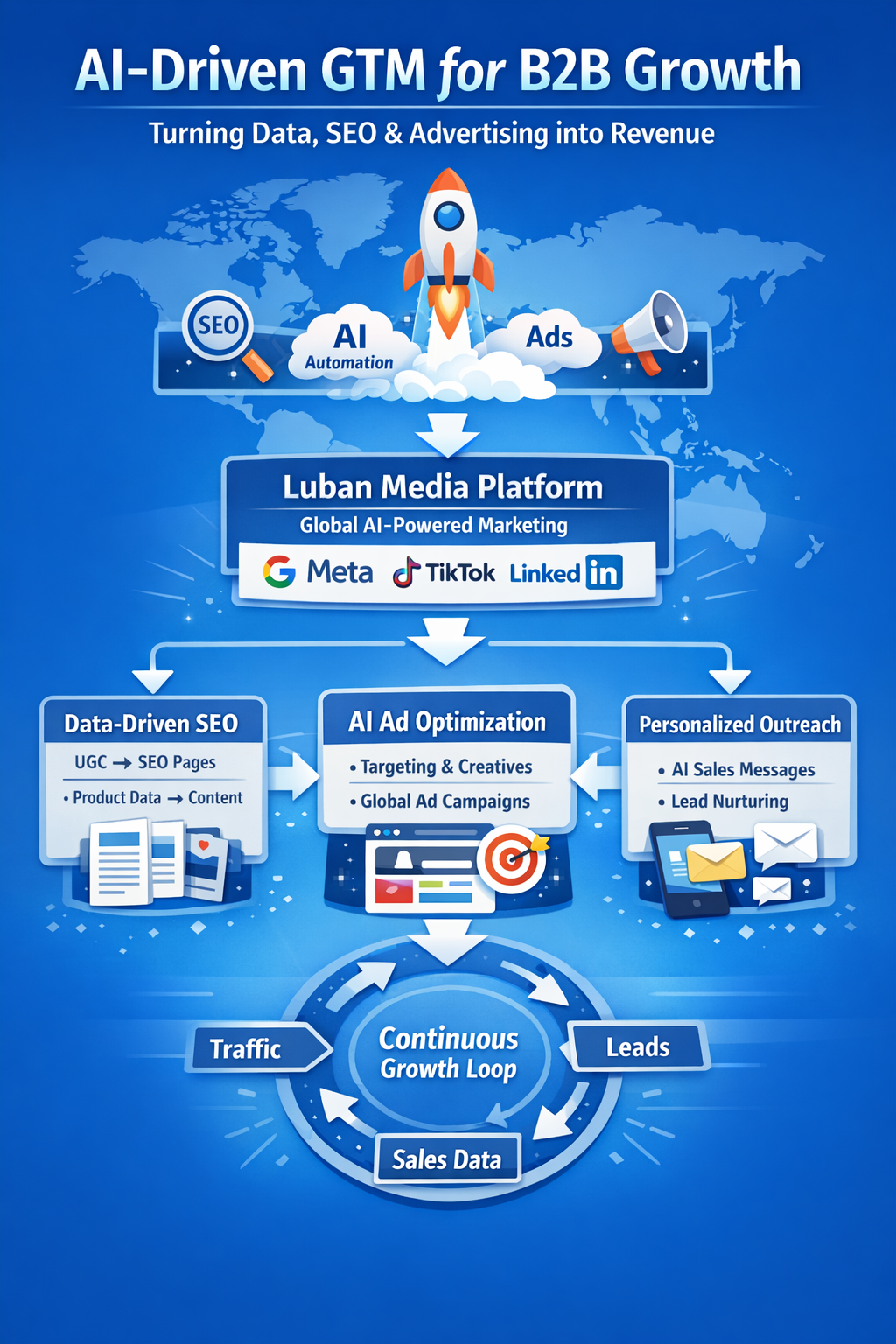
Data-Driven SEO and GEO: Turning Data into Traffic
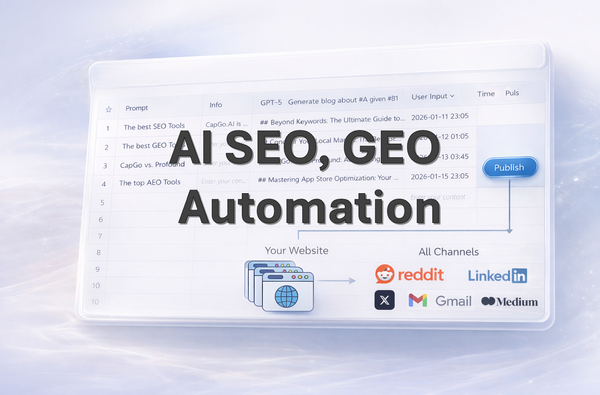
One of the most powerful uses of AI in B2B marketing is data-driven SEO. Instead of relying on manually written articles, companies can convert structured datasets into thousands of search-optimized pages.
These pages are designed not only for traditional search engines like Google but also for AI search systems such as ChatGPT and other generative engines—an emerging practice known as Generative Engine Optimization (GEO).
Two of the most effective methods are UGC-driven SEO and product data–driven SEO.
UGC Data → SEO Content
Many B2B companies already have valuable datasets generated by users or customers, including:
- customer questions
- product usage examples
- community discussions
- support tickets
- industry insights
AI can analyze this data and transform it into structured SEO content. Because the topics originate from real user questions, the resulting pages match search intent extremely well.
For example, a SaaS company might automatically generate pages like:
- “Best tools for AI sales automation”
- “How B2B founders build growth pipelines”
- “Top strategies for scaling outbound sales”
This approach dramatically expands a company’s presence in search results.
SKU and Product Data → Programmatic SEO
Another powerful dataset inside many companies is product or feature data.
For software companies, this may include:
- integrations
- features
- industry use cases
- pricing tiers
- customer segments
AI can convert this structured information into large numbers of SEO pages—often called programmatic SEO.
Examples include:
- integration pages for each software platform
- comparison pages against competitors
- feature-specific landing pages
- use-case documentation
These pages capture long-tail search traffic that traditional marketing often overlooks.
Luban Media and the Rise of AI-Driven Global Advertising
As companies scale their GTM strategies internationally, advertising remains a critical component of growth. However, managing campaigns across multiple global platforms can be complex.
This is where ecosystems like Luban Media become particularly valuable.
Luban Media (https://lubanmedia.com/index), part of the BlueFocus marketing technology group, operates as a global advertising and marketing platform designed to help companies expand internationally. It integrates advertising across more than twenty major platforms—including Google, Meta, TikTok, and LinkedIn—while also providing AI-assisted marketing tools.
For companies pursuing AI-driven GTM strategies, Luban offers several advantages.
First, it provides centralized advertising infrastructure. Instead of managing campaigns separately on multiple platforms, companies can coordinate global campaigns through a unified system.
Second, Luban supports data-driven campaign optimization. AI tools analyze advertising performance, audience behavior, and creative variations to improve campaign efficiency and return on ad spend.
Third, the platform integrates creative production and performance marketing workflows, enabling teams to generate and test large volumes of advertising creatives quickly.
In many ways, Luban represents the broader shift toward AI-enabled marketing ecosystems, where advertising, data analytics, and content generation operate together rather than as separate functions.
AI Advertising Optimization
Advertising platforms generate enormous amounts of performance data. AI can process this data far faster than traditional marketing teams, enabling more effective campaign optimization.
Key areas where AI improves advertising include:
- identifying high-performing audiences
- generating new ad creatives automatically
- optimizing campaign structures
- adjusting budgets based on real-time performance
Instead of running a handful of static campaigns, AI allows companies to test hundreds of variations of messaging and targeting.
This approach leads to more efficient customer acquisition and stronger campaign performance across global markets.
AI-Generated Personalized Outreach
The final stage of a modern GTM system focuses on converting traffic into leads and customers.
AI makes it possible to generate highly personalized messages for each prospect. These messages can incorporate multiple data signals, such as:
- company size and industry
- website activity
- product usage behavior
- search queries
- previous interactions
Using these signals, AI can generate tailored messages for channels like:
- email outreach
- LinkedIn messaging
- website chat assistants
- retargeting campaigns
Because the messaging reflects each prospect’s interests and context, response rates tend to increase significantly.
The New GTM Engine
The most advanced B2B companies are building continuous AI-powered GTM systems.
The growth loop looks like this:
- Internal data becomes SEO and GEO content
- SEO traffic reveals new customer interests
- Advertising campaigns amplify high-performing topics
- Personalized outreach converts visitors into leads
- Sales interactions generate new datasets
These insights feed back into the system, creating a continuous cycle of learning and growth.
Building the Future of B2B Growth
AI is transforming how companies approach go-to-market strategy. Instead of relying on manual marketing efforts, businesses can now build systems that automatically convert data into traffic, campaigns, and sales opportunities.
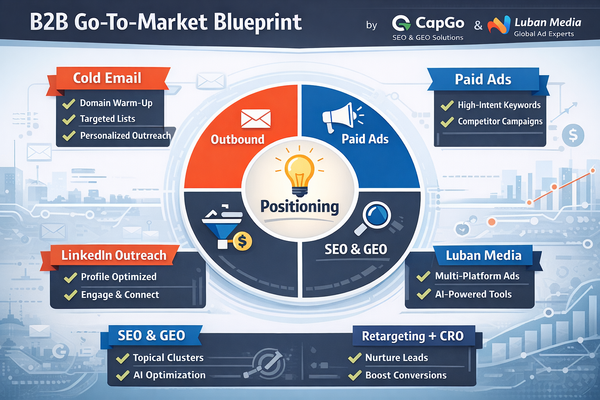
By combining data-driven SEO, AI-optimized advertising platforms like Luban Media, and personalized outreach, companies can build GTM engines capable of scaling globally.
In a world where search engines, AI assistants, and advertising platforms are increasingly interconnected, the organizations that succeed will be those that treat data as the foundation of their marketing strategy—and AI as the engine that turns that data into growth. 🚀